Change and crises in West Africa: What if culture were the solution?
1/12/25
Faced with the political crises and profound changes shaking West Africa, Professor Mamadou FALL of Cheikh Anta Diop University in Dakar proposes a bold path: transforming culture from mere decoration into the primary engine of societal renewal. It is a powerful vision for rehabilitating indigenous knowledge and building a sovereign future.
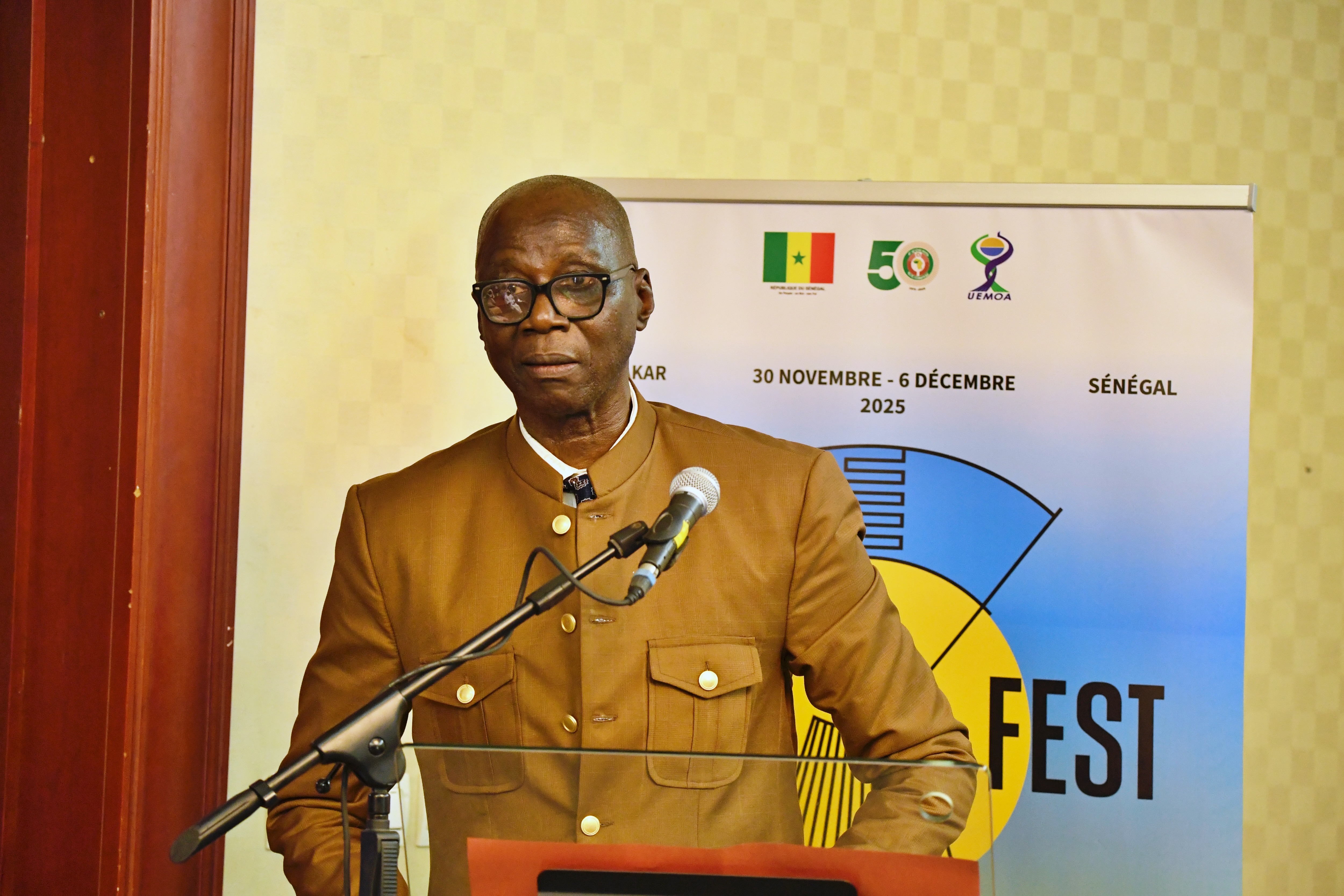
As West Africa navigates decades of turbulence, marked by political crises, identity tensions, and persistent marginalization on the global stage, a nagging question remains: where lies the key to true sovereignty?
For Professor Mamadou FALL, the answer lies not only in the political or economic spheres, but in a domain that has been underestimated for too long: culture. During the inaugural lecture on "Mutations and Political Crises in West Africa: What Can Culture Do?", delivered on December 1, 2025, as part of the first edition of the West African Festival of Arts and Culture (ECOFEST), he delivered a masterclass rich with impactful messages.
Before an informed audience, including the Senegalese Secretary of State for Culture, Creative Industries, and Historical Heritage, Mr. Bakary SARR, and the Commissioner for Human Development and Social Affairs of the Economic Community of West African States (ECOWAS), Professor Fatou Sow SARR, Professor FALL called for a true Copernican revolution, inviting us to "break free from the Western sponge" to rehabilitate the creative power of African legacies.
The observation of alienation
The diagnosis made by Professor FALL is uncompromising. For too long, African cultures have been perceived and studied through the distorting prism of the Western gaze.
"Our languages, rituals, myths, proverbs, and arts have been reduced to ethnographic documents—objects of study rather than legitimate sources of knowledge, rights, philosophies, or sciences,"he laments.
This vision has not only shaped the dominant narrative on the continent but has also been internalized by some of its elites, leading to a form of alienation. By neglecting their own production of meaning and values, African societies have deprived themselves of an essential lever, fueling "underdevelopment, marginalization, and conflict."
"A cultural tradition is not a museum subject, but a three-stage movement: an initial creative action, a collective commitment that becomes institutionalized, and a cumulative interaction," the Senegalese academic emphasizes.
To reverse this trend, Professor FALL insists on the need to redefine culture itself. Far from the frozen image of backward-looking folklore, he conceives of it as a dynamic process, a " three-stage movement".
Everything begins with a creative spark, which then spreads within a community to finally become the foundation for new creations. It is this creative interdependence that gives culture its power to act deeply "on chains of meaning, on shared values, and on the collective imagination".
The three levers of renewal
To move from vision to action, Professor FALL identifies a mission for what he calls the "generation of cultural refounders". This new generation must rely on three strategic levers to re-anchor Africa in its own historical and cultural trajectory.
First, refocus cultural production on daily life. This involves valuing the places where meaning, the sacred, and beauty are created in the lives of communities, by considering West African cultures as a living heritage rather than mere decoration.
Next, we must restore a shared historical dimension. The challenge is to write the continent's history based on its own temporalities, rather than as a succession of episodes linked to European history. This implies recognizing myths and cosmologies as legitimate frameworks for imagining the future.
Finally, we must build intercultural skills. This third lever involves bridging science, the arts, and modern technologies—particularly artificial intelligence—to give universal visibility and validity to knowledge produced in Africa. The goal is for the continent to become a "co-producer of meaning" on the global stage.
Concrete tools for a connected future
Professor FALL's proposal is more than just an intellectual manifesto; it is accompanied by concrete and resolutely modern tools. He advocates for the creation of "large-scale historical and cultural databases" in every country, compiling archives, manuscripts, life stories, epics, and both tangible and intangible heritage. These massive corpora would be used to train "digital tutors" or chatbots capable of making this knowledge accessible to everyone, in both local and international languages.
Artificial intelligence is no longer viewed as a threat, but as "an instrument of hermeneutics", a way to make all voices audible, to map social dynamics, and to reopen the paths of the past. This alliance between tradition and cutting-edge technology is at the heart of his vision.
"It is about building solid bridges between academic knowledge, indigenous knowledge, and community reality," he explains.
Beyond the digital realm, Professor FALL highlights powerful legal and economic instruments. "Collective trademarks" and "geographical indications" are presented as strategic tools for transforming cultural identity into shared economic power.
By protecting the origin and quality of products or expertise rooted in a specific region (whether pastoral products from the Sahel, artisanal techniques, or ritual practices), these labels strengthen community identity, create value, and reconstruct historical ties fragmented by colonial borders.
Cultural tourism, structured around these brands, thus becomes a vector for sustainable development, creating authentic "itineraries, festivals, markets, and community experiences."
The return of the vernacular
In conclusion, Professor Mamadou FALL's message rings out as a vibrant call for optimism and action. The "great revolution of our time," he asserts, is "the unexpected return of the vernacular to the public sphere."
Languages, aesthetics, and local references are regaining dignity and visibility, carried by new technologies that allow for their large-scale dissemination.
In a world in search of meaning, the richness of West African cultures is no longer a relic to be preserved, but a vital resource for inventing the future.
A future where West Africa, empowered by its rehabilitated heritage, no longer endures history but co-writes it, in full possession of its capabilities and its imagination.